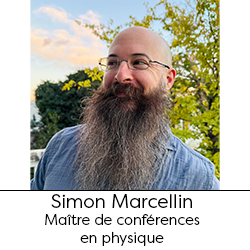
[Portrait] Simon Marcellin, Senior Lecturer in Physics (UMR EMMAH)
What is your research about?
One of the research areas of the’UMR EMMAH relates to characterisation of complex environments using non-invasive methods. Since soil is a particularly heterogeneous medium and radar waves are non-destructive, I am logically moving towards optimising geo-radar imaging. This is consistent with my previous work on the propagation of electromagnetic waves in sub-wavelength structures. For radars, the air-ground interface poses a major problem: a large portion of the signal is reflected there, severely limiting ground imaging capabilities.
Solutions exist to optimise coupling at the interface (known in technical jargon as impedance matching) and are fairly intuitive to understand: Similar to the gel used in Doppler ultrasound to promote wave penetration, my goal is to design an interface structure (a metasurface) capable of maximising the transmission of radar waves into the ground and improving image quality. Simple on paper, but complex to achieve, of course: this work is at the crossroads of applied mathematics for the inversion component (reconstructing the properties of the medium) and numerical physics (for designing the metasurface), and requires the practical skills of an engineer, since the devices will be manufactured and tested in the field.
What are your current scientific activities?
I'm still a novice researcher, but fortunately, I've just landed an ANR Young Researchers Grant (JCJC) in 2025. It runs until 2029 and will enable me to supervise a PhD student from 2026 onwards and four Master's 2 students over four years, via the METINVERSE project, i.e. the optimisation of the metasurface described above. This topic is likely to become an important focus for the PHYSICS team in the coming years, with almost every member involved to a greater or lesser extent.
Why did you choose to work in academic research?
I saw the light, so I came back! To be honest, it's half a joke. From secondary school onwards, I knew I wanted to study physics for a long time. I felt comfortable with it, but I still had doubts and, above all, I couldn't imagine making it my career. At the time, I knew nothing about the various branches of this discipline. Even after completing my PhD—which is specifically designed to prepare students for this—I thought that academic research was not for me after all. With a little hindsight, and thanks to my various post-doctoral experiences, I changed my mind, both in terms of the discipline and on a personal level. There are some extraordinary people in this profession! And there is still so much to do, despite the sheer volume of global scientific output and the difficulty of navigating it all.
What advice would you give to students who want to do research?
Go for it! There are certainly a thousand possible criticisms, both circumstantial and structural. On an individual level, you also have to be able to cope with setbacks, but it remains a profession that offers immense freedom of action, constant intellectual stimulation and long-term wonder. We sometimes come across jaded or disillusioned researchers, but — perhaps this is the naivety of the young researcher speaking? — I am convinced that it is impossible to tire of this profession as long as you continue to feed your curiosity. If, during your studies, you were inspired by even the tiniest aspect of a micro-discipline, go for it! There is certainly a whole world to explore.
What object or image from your business best illustrates you?
I spend most of my days behind a computer: firstly because my research is mainly based on numerical simulation, but also because, as a senior lecturer, I am constantly answering emails — legend has it that we are the best-paid secretaries on the market! That said, I would rather share with you some photos of outdoor measurements, taken recently with our team's seismic devices and ground-penetrating radar. This remains representative of part of the profession... and it is much more photogenic!
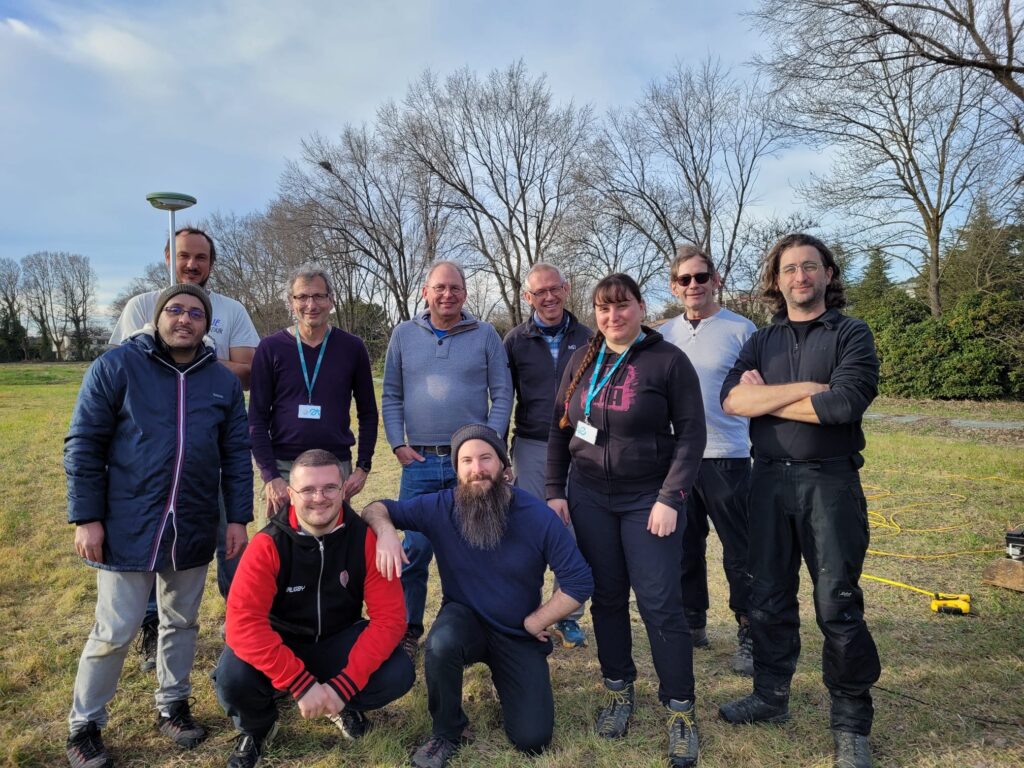
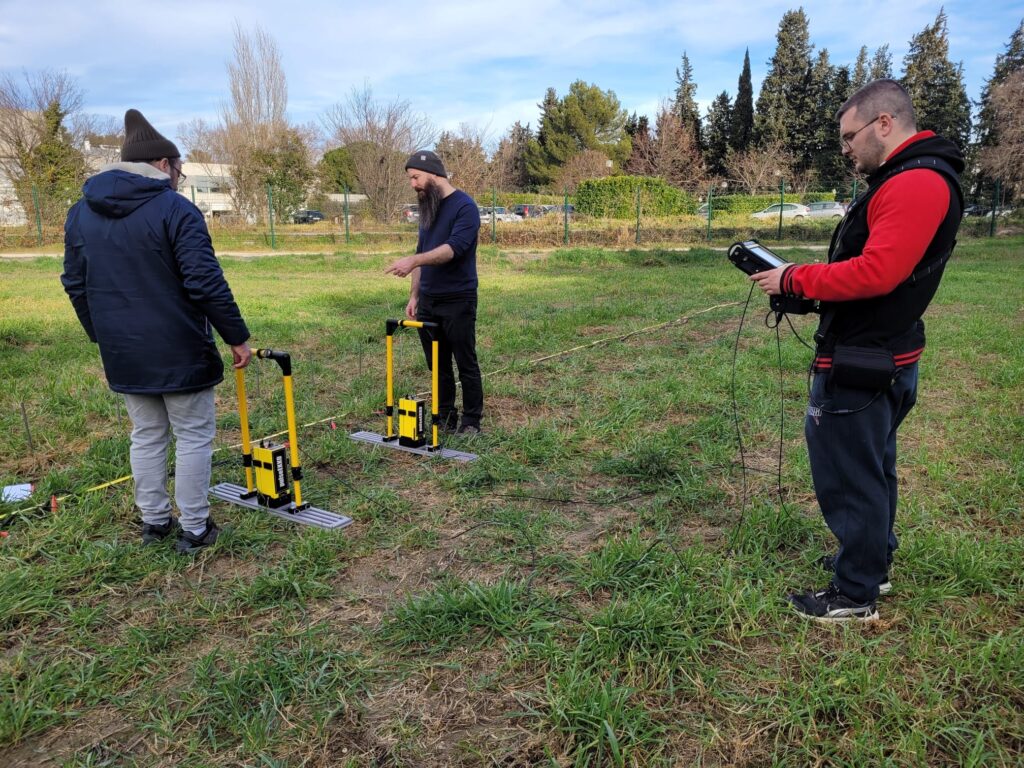
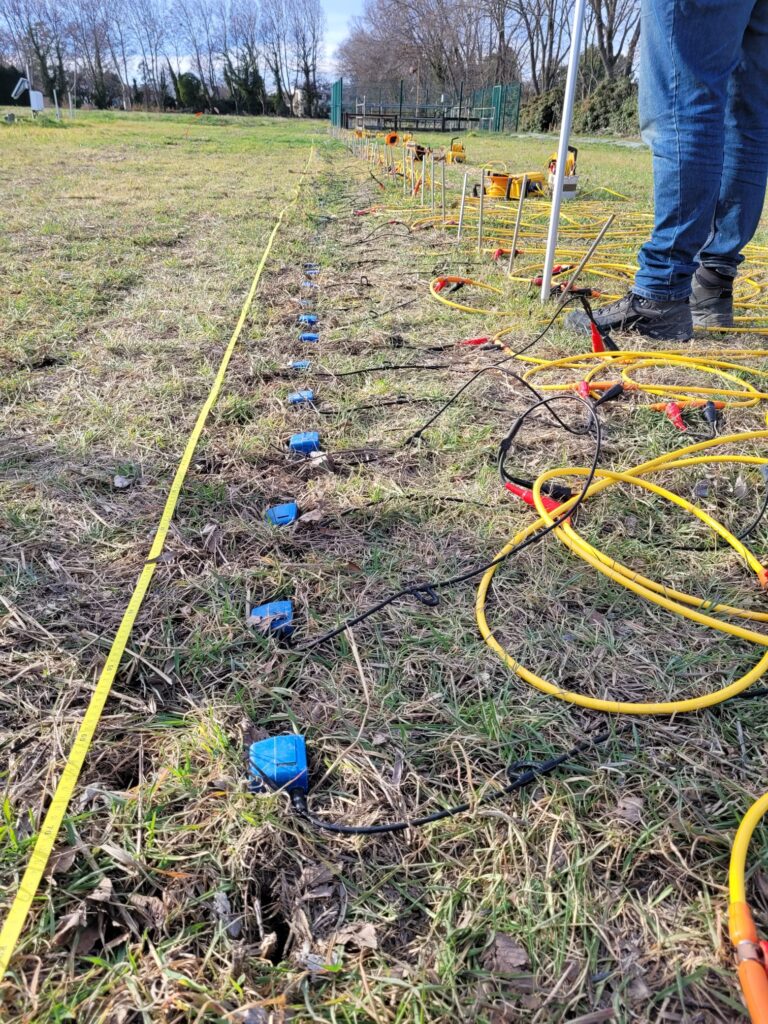
The EMMAH laboratory
The research carried out by the EMMAH joint research unit focuses on understanding and modelling the functioning of agrosystems in interaction with underground hydrosystems. This leads the UMR to consider the aquifer-soil-plant-atmosphere system on different time and space scales. In order to understand and model how this system works, it is necessary to take into account the many interactions between the dynamics of the plant cover, the physical, chemical and biological processes in the soil, interactions with the atmosphere and hydrosystems, and the way in which agrosystems are managed. In particular, the work carried out aims to characterise mass flows between the atmosphere, the plant cover, the soil and the underground aquifer, and the processes involved in plant production in relation to environmental factors, at different spatial scales (from a millimetre to a kilometre) and temporal scales (from a second to several decades). In this way, the EMMAH joint research unit is helping to assess the sustainability of underground water resources and cropping systems in the dual context of global change and agro-ecological transition. The Mediterranean remains a key area of study, a region marked by rapid climate change and high water stress linked to the adaptation of cropping systems and strong demographic pressure.
>> UMR 1114 EMMAH - Mediterranean Environment and Modelling of Agrohydrosystems
Research portraits
Updated on 1 December 2025