Portraits - 8 March 2026: a look at four women's journeys to university
To mark International Women's Rights Day 2026, Avignon Université is honouring four women with inspiring careers in a variety of fields, from scientific publishing to environmental sciences and information and communication sciences. Through their research, their responsibilities and their day-to-day involvement, they are actively contributing to the scientific and academic dynamism of the institution.
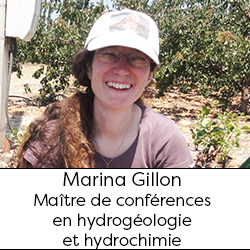
Marina Gillon is a lecturer in hydrogeology and hydrochemistry in the hydro team at UMR EMMAH.
Sound The aim of this research is to understand how hydrosystems function by exploiting the potential of geochemical and isotopic tools. (in particular, the chemistry of major elements dissolved in water, 18O, 2H, 13C, 14C). She is particularly interested in the interactions between surface water and groundwater, the interactions between gas, water and rocks, and the transfer time of water in the underground environment.
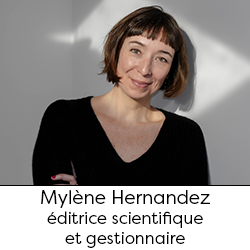
Mylène Hernandez is a scientific editor and manager (university library, Editions Universitaires d'Avignon).
Books and the written word are at the heart of his work, as well as scientific publishing, It's something she's wanted to do for a long time. In 2021, she joined an associative publishing collective, an exciting and instructive experience. Two years later, she trained as a multimedia editorial secretary. She then redirected her career towards the’public scientific publishing.
At Éditions Universitaires d'Avignon (EUA), among other things, she is responsible for steering editorial projects, preparing copy, administering and running the department, as well as distributing and promoting editorial productions.
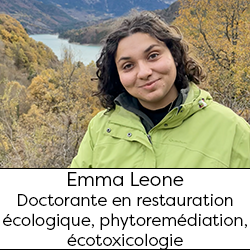
Emma Leone is a PhD student in ecological restoration, phytoremediation and ecotoxicology in the EECAR team at UMR IMBE.
His research project focuses on restoration of part of the Crau plain, marked by the’legacy of munitions burnt during the Second World War. It is particularly interested in nature-based solutions for sustainably restoring this environment. The emphasis is on phytostabilisation, using a dominant pseudo-metallophyte plant species from the Crau plain: Brachypodium retusum. The aim is to combine environmental diagnosis and natural mechanisms to reconcile rehabilitation and preservation of local biodiversity.
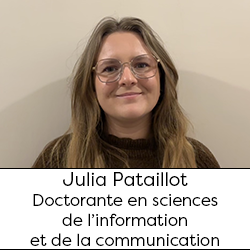
Julia Pataillot is a doctoral student in information and communication sciences at the Centre Norbert Elias.
His thesis focuses on representations of psychiatry in film Her research focuses on the multiplicity and diversity of psychiatric figures, combining semiological, aesthetic and sociological approaches. She seeks to understand the place of fascination and stigmatisation and, by extension, the societal impact of these representations outside the realm of fiction.
Updated on 6 March 2026