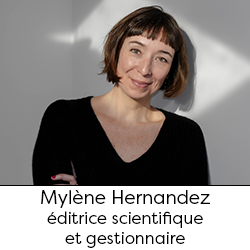
[Portrait] Mylène Hernandez, scientific editor and manager (university library, Editions Universitaires d'Avignon)
What is your job?
Before describing my role at the university, I'd like to say a few words about my background. As a self-financed student, I worked throughout my studies. I was bookseller, lecturer in anthropology and sociology, trainer and professional writing methodologist for social work students. Alongside these activities, I regularly proofread, edit and translate social science texts. As for my studies, I went to the’École des Hautes Études en Sciences Sociales. I studied ethnology and, in fine, I have a thesis in social and historical anthropology. My discipline : the anthropology of kinship. My speciality is German relationships. I investigated the moral obligation between brothers and sisters in siblings affected by autism. Then, as part of two post-doctorates at the CNRS, I worked on adoption - more specifically on irregular practices in international adoption - and then on intra-family solidarity in kin groups affected by orphanhood.
Books and the written word are at the heart of my path, as is scientific publishing, which I have wanted to do for a long time. In 2021, I joined an associative publishing group, an exciting and instructive experience. Two years later, I trained as a multimedia editorial secretary. So I redirected my career towards public scientific publishing. That's how I arrived at Éditions universitaires d'Avignon (EUA) in October 2024.
At the EUA, among other things, I'm in charge of managing editorial projects, preparing copy, administering and running the department, as well as distributing and promoting editorial productions.
What is its link with Research?
When scientific knowledge is produced, it only really exists in the academic field if it is evaluated, structured and disseminated. This is precisely where scientific publishing comes in. It contributes to the consolidation of knowledge by implementing demanding editorial processes (peer review, standardisation, formatting) and works to disseminate it within the scientific community and beyond. Public scientific publishing is therefore a natural extension of research work. It plays a full part in the public service mission of universities.
What does it mean to you to work at a university?
Working at university is a choice I've taken fully on board. I can't imagine walking away from the most meaningful and important thing in my life: to learn, to pass on, to stay intellectually, ethically and aesthetically alert, to work as part of a collective, to contribute to what is common to us all. This is a terrifying political moment. The discrediting of scientific knowledge, the political strategies aimed at simplifying and binarising any complex issue, the proliferation of authoritarian discourse and political violence - all these are having very real effects. In this context, learning, transmitting and fostering challenging forums for discussion are not superfluous; they are an absolute necessity. Despite its weaknesses, the university is still a place where we can think collectively, challenge, verify and argue.
What advice would you give to people who want to work in research support?
Cultivate a posture of intellectual openness. Read scientific content as well as poetry, literature, comics, manga and the press. Watch all the films you can, as well as documentaries. Go and see exhibitions. Observe your surroundings. Discuss. Doubt. Make links between scientific and cultural knowledge, between fields, people and ideas. Allow yourself to appropriate knowledge - whatever it may be.
The portraits
Updated on 5 March 2026