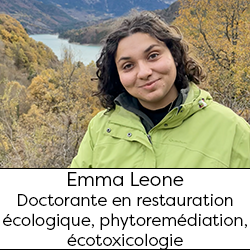
[Portrait] Emma Leone, doctoral student in ecological restoration, phytoremediation and ecotoxicology (IMBE EECAR)
What is your research about?
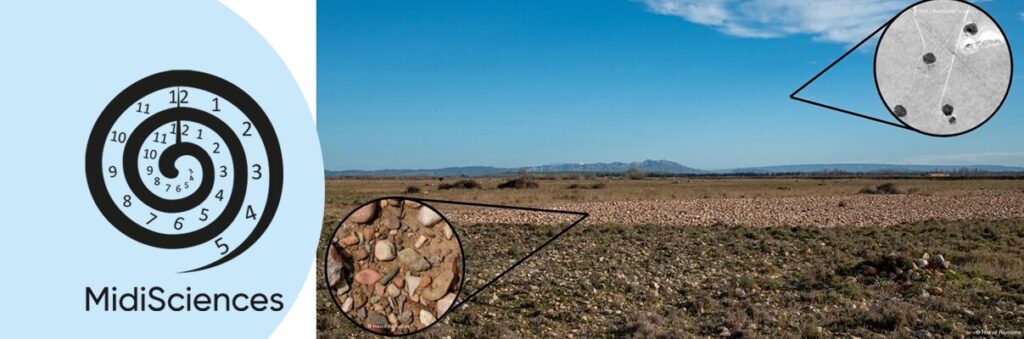
My research project focuses on restoration of part of the Crau plain, marked by the’legacy of munitions burnt during the Second World War. I'm particularly interested in nature-based solutions for sustainably restoring this environment. The emphasis is on phytostabilisation, with the use of a dominant pseudo-metallophyte plant species from the Crau plain: Brachypodium retusum. The aim is to combine environmental diagnosis and natural mechanisms to reconcile rehabilitation and preservation of local biodiversity.
What are your current scientific activities?
I'm currently in my second year of a PhD and am fully committed to writing my first scientific article, based on my research work. It is due to be submitted very soon. This marks an important step forward in my academic career and is in line with my objectives of scientific promotion.
Why did you choose to work in academic research?
I chose to go into university research so that I could reconciling research and teaching. Thanks to my mentoring contract, I have the opportunity to pass on my knowledge while sharing my passion for research with students. Participating in their training and helping to awaken their scientific curiosity is a particularly important source of motivation and satisfaction for me.
What advice would you give to students who want to do research?
I would say that the most important quality for doing research is motivation. Research requires curiosity, perseverance and the ability to accept that not everything works the first time. You have to enjoy asking questions and seeking to understand things in depth. If you're really passionate about a subject, then investment and effort come naturally.
What object or image from your business best illustrates you?
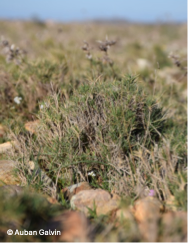
This photo shows Brachypodium retusum, the species at the heart of my thesis. Highly tolerant of drought, grazing and wind, it is also an ingenious natural tool for soil contamination by metals.
Not to be missed
On 9 April 2026, Emma Leone will be hosting a Midiscience on the subject of «Contamination rooted in time: 78 years of pollution following the burning of munitions in a protected natural area».», on the Jean-Henri Fabre campus, Agrosciences amphitheatre, from 1pm to 2pm.
UMR IMBE - EECAR team
Faced with the erosion of biodiversity due to global changes (land use, climate, biological invasions, pollution), theEECAR team seeks to develop approaches for diagnosing the state of health of ecosystems, and to produce original results and innovations for ecological restoration or the sustainable management of natural and cultural heritage, as well as assessing their effects and legal prospects.
On the one hand, the team relies on ecotoxicological approaches (development of biomarkers, in particular) and chemical (research into chemomarkers) and on the other hand, on the characterisation of populations and communities (vegetation, terrestrial invertebrates)The aim is to identify bioindicators and gain a better understanding of the relationship between biodiversity and ecosystem functioning.
The approaches used stem from therestoration ecologytheecological engineeringtheagroecologythe nature protection law and chemistry heritage. They enable EECAR to contribute to conservation-restoration of cultural heritagethe protecting, restoring and rehabilitating socio-ecosystems as well as the implementation of a sustainable management of agroecosystems. The team is also studying the legal instruments used to prevent damage to the natural environment, as well as their compensation systems.
Research portraits
Updated on 5 March 2026